Feb 17, 2011

"I call myself a
chlorophyll whore"
C.Colston Burrell

C.Colston Burrell
NATIVE plants
and
ECOLOGICAL design

11th Annual Winter Lecture Series
New York Botanical Garden
February 17, 2011
C. Colston Burrell is a garden designer, award-winning author,
photographer,
naturalist, and teacher.
Is it possible to do all that, know all that...I went to find out.


And it is possible to be particularly engaging and modest at the same time.

Burrell is a Southerner and it shows.  His manner mixes old-fashioned charm with 21st. century knowledge.  He began with "I want to share with you a lifetime of discovery."  When someone wants to SHARE with me, I am immediately positively disposed towards them. 

Burrell set the parameters for the discussion.  He is not purist or heretic, somewhere near the purist, but with a mixture of realism.  
He invoked the mantra of the sustainable sites movement:  DO NO HARM.  And then he asked the question what is native plant?
1.  a plant with medicinal value
2.  a plant that provides food
3.  a plant that adorns the landscape
4.  a plant that can be used as a tool for restortion
5.  a plant that is an object of desire
6.  a plant that is part of food web
7.  a plant to is a structural component in a plant community

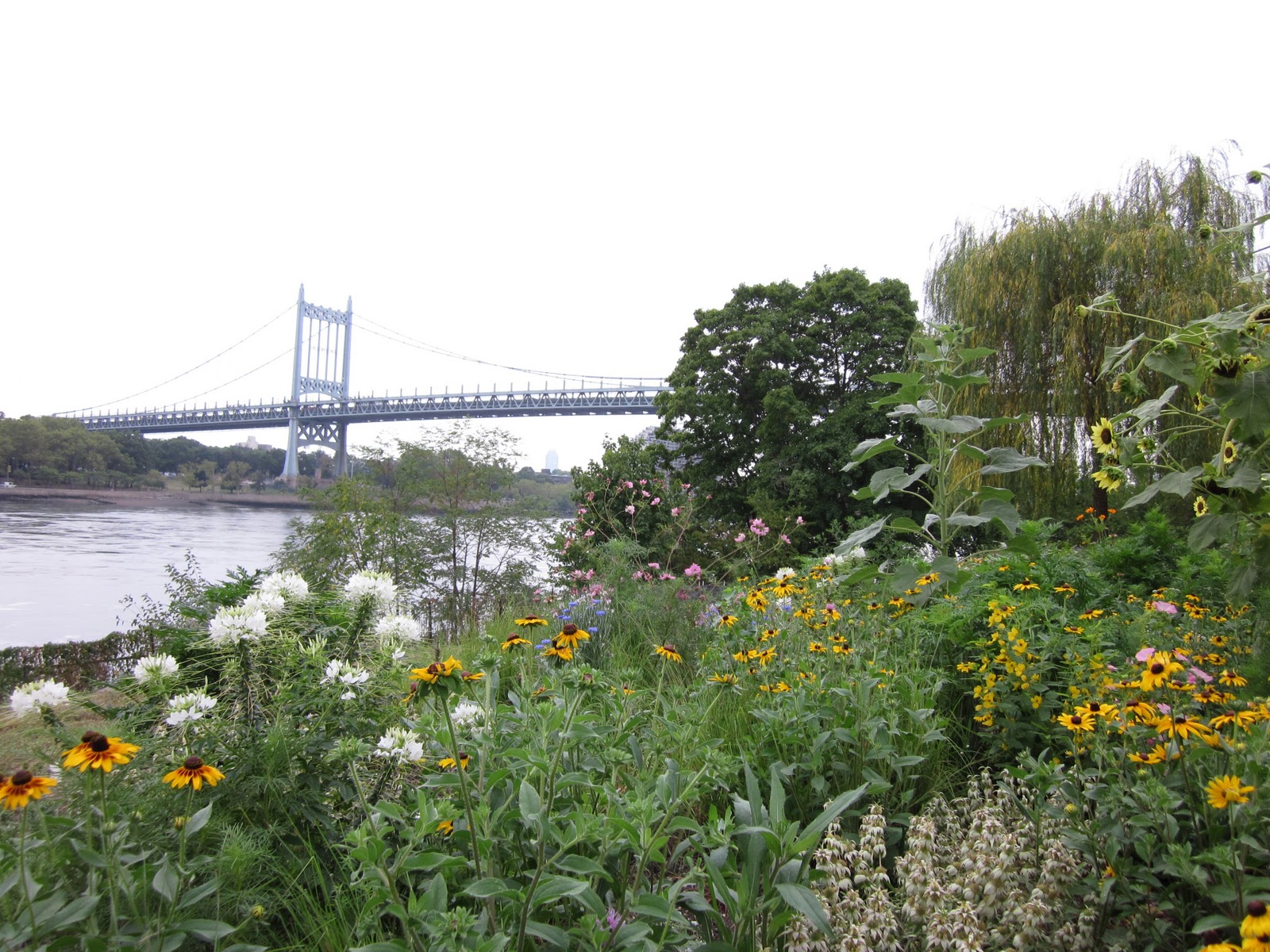
The native wildflower meadow at Randall's Island facing the Harlem River

Burrell traced the evolution of native plant movement/revival.
The call to arms:  think globally, act locally. 
The bumper sticker on his car:  DARWIN LOVES YOU.
Without recounting the entire lecture, as they say you can buy the book or books, Burrell ended the lecture by going locally...talking about his own garden.  A combination of garden and woodland. 
"I am a lazy gardener.   Native plants are a great way to sit outside, watch the butterflies, dragon flies, hummingbirds and have a glass of wine."  Burrell has a deer fence, which made him extremely happy, until the voles, moles, rabbits, skunks, and woodchucks invaded.  "Now, I 'm happy if it just lives, self-sows and makes a colony."

So am I.


C.Colston Burrell is a garden designer, award-winning author, photographer, naturalist, and teacher.  He is a lecturer in the College of Architecture and Landscape Architecture at the University of Virginia and principal of Native Landscape Design and Restoration.  He is the author of many gardening books adn has twice won the American Horticulture Society book award (in 2007 for Hellebores: A Comprehensive Guide and in 1998 for A Gardener's Encyclopedia of Wildflowers).  He is contributing editor for Horticulture and frequently write for Landscape Architecture and American Gardener.

Feb 14, 2011

Aesthetic Moment

Photograph by Eunyoung Sebazco
I went for the ideas more than the food or flowers, although little snacks do increase my ability to digest new ideas.  Bloom Japan at Japan Society was a show geared toward floral designers.  The mission to promote the use of Japanese flowers in the US. 
Photograph by Eunyoung Sebazco
Above two photographs by Eunyoung Sebazco.
The room was filled with Camellia japonica from Akebono to Tatkantubaki, Cymbidium  as delicate Marie Laurencin and as bold as Smirnoff, Lathyrus odoratus Royal Blue (dyed Royal Blue) and Mid Night (naturally the color of night) but for me it was Senecio rowleyanus Green Necklace, Spiraea cantoniensis Kodemari, and Asplenium Crispy Wave that were the real stars.  As we all know the Japanese use conifers, and in fact, green plants in arrangements that are close to magic. 
Photograph by Eunyoung Sebazco

Perhaps, because I was walking around the room with a dazed expression, a microphone was stuck in my face.  A Japanese TV crew asked me to do an interview.  I don't like to be a shill, but it was quickly apparent what was expected.  I wanted to give them what they needed.  In fact, I wanted my 15 seconds of fame to be like the origins of Ikebana:  the offering of flowers on the altar in honor of Buddha.
 Photograph by Eunyoung Sebazco

Feb 11, 2011

You say you want
a REVOLUTION

Well, you know
We all want to change the world
...
                             but the Egyptians actually changed their world today.

       How can we as gardeners celebrate this moment? 
Today, I wrote a grant proposal for the planting of bulbs.  When I arrived home and heard the news, I decided to change my bulb proposal. I am going to plant Narcissus(an ancient Egyptian bulb) in honor of the Egyptians, who held fast and won their freedom.
I don't have a right environment, but if I did I might want to grow:
PAPYRUS
LOTUS
      Well, you know
         We might all want to honor this moment.


BARKing up the right tree:
Vincent Simeone

 WONDERS of the WINTER
LANDSCAPE
Vincent A. Simeone
The Horticultural Society of New York
February 10

Winter interest in the garden has become a cliche subject matter.  But there were some people, who were on to it before it became fashionable. Vincent Simeone was one of those people.  He knows the role of texture and form in the winter scene.
White on White by Malevich
To me the winter landscape of 2010-11 has seemed more white on white, than anything else; I've gone over to BARK-side.  These are my picks:
ACER GRISEUM 'Cinnamon Flakes'
native to China
BARK exfoliating to cinnamon-color
flakes in smaller strips than its cousins.
HEPTACODIUM MICONIOIDES
native to China
 white flowers in clusters of seven, 
which smell kind of like jasmine
 BARK tan that exfoliates to brown inner bark

PARROTIA PERSCIA
native to Iran
 BARK peeling to reveal gray, green, white, brown
and surprisingly it belongs to the Hamamelidaceae family


STEWARDIA PSEUDOCAMELLIA
native to Japan
has white camellia-like flowers
BARK has incredible camouflage pattern
of orange, green, grey


The best thing to do when there is this much white stuff around...
love it!
___________________________________
For a really good read...
redefining the meaning of Winter in the garden
New York Times Home and Garden section
Thursday, February 10, 2011
Interview with Piet Outdolf
http://www.nytimes.com/2011/02/10/garden/10garden.html?_r=1&ref=garden

Feb 3, 2011

Stories To Tell

enverscompagnie.com
Starting a vegetable garden requires some heavy lifting, not only physically, but intellectually.  Choosing which variety to plant was only half the story.
Calabrese VS.  Romanesco BROCCOLI
Scarlet Nantes vs. St. Valery CARROTS
Boothby's  Blonde vs. Crystal Apple CUCUMBERS
Goyo Kumba vs. Listada de Gandia EGGPLANTS
Broadleaf Czech vs. Chesnok Red GARLIC
Bleu de Solaise vs. Giant Musselburgh LEEKS
Bunte Forellenschluss
Cracoviensis
Lolla Rossa
Merveille de Quatre Saisons
Reine des Glaces
Rossimo
Rossa di Trento

LETTUCE

  A vegetable garden to feed my face and... a vegetable garden with stories to tell. I want it ALL.
activerain.com/guardian.co.uk
CHEROKEE TRAIL OF TEARS BEAN
Memorializes the forced relocation of the Cherokee Indians in the mid-nineteenth century.  The Cherokees carried this bean over the Trail of Tears, the infamous winter death march from the Smoky Mountains to Oklahoma (1838-1839) leaving a trail of 4,000 graves.
origin of the story:  www.slowfood.org
eatyourfeelings.recipesforselfloathing.blogspot/bidorbuy.co.za
LAZY HOUSEWIFE BEAN
The bean was introduced by the Pennsylvania Dutch and was well known in early 1800's in Bucks County, PA.  The Lazy Housewife is one of the oldest documented beans and so named because it was the first snap bean that did not need to have the string removed.  In 1907, the Lazy Housewife was the third most popular bean in the US.
origin of the story:  www.seedsavers.org

art.newcity.com/ecomene.com
ROUGE CRAPAUDINE BEET

According to botanical historian, Andrew Dalby, a beet mentioned in a Greek document from 320 B.C was most likely the precursor of the 'Rouge Crapaudine' familiar to French gardeners since 1600.  "I love the Crapaudine, because not only does it taste light years better than other beet, but because it is the "Uhr-beet" the original, as close to the untamed wild beet as we can come."
origin of the story:  www.frenchgardening.com


loumarinoff.com/rareseeds.com
JAPANESE SHISIGATANI OR TOONAS MAKINO SQUASH
This unique Japanese pumpkin was developed in the Bunka era of the Edo period (1848-1818).  The fruit is uniquely shaped, like a bottle gourd, ribbed and very warty.  It is dark green, turning to tan.  Traditionally believed to keep people from getting paralysis, if eaten in the hottest part of the summer.
origin of the story:  bakercreedheirloomseeds


digitalbotanicalgarden.blogspot /commons.wikimedia.org

QUEEN ANNE POCKET MELON
According to digitalbotanical.blogspot, the main reason for growing the Queen Anne Melon, apart from its ornamental properties, is its incredibly intense melon fragrance.  One ripe fruit, which lasts for about ten days before it goes soft, will perfume a whole room.  Victorian ladies used to carry them around in their pockets, as a kind of portable pomander.
origin of the story:  digitalblogspot.com
cottagegardener.com/ayrshireroots.com
ALISA CRAIG ONION
Developed in 1867 by David Murray, gardener for the Marquis of Alisa at Culzean Castle in Maybole, South Ayrshire, Scotland.  Either the Marquis or his gardener named the onion after the island, which means "fairy rock."  Some sources say the name was chosen because the island looks like an onion.

The island is 3km in circumference and consists entirely of the volcanic plug of an extinct volcano that might have been active about 500 million years ago.  So how did the onion manage to grow?

From the mid-19th to mid-20th centuries, the island was quarried for its rare type of micro-granite with riebeckite (known as "Allsite") which is used to make curling stones.
origin of the story:  www.seedsavers.org

seedsbydesign.com/fordfinancial.wordpress.com
MORTGAGE LIFTER TOMATO
Developed by M.C. Byles in the 1930's, this tomato remains very much in demand in the Mid-Atlantic states.  Mr. Byles, affectionately known as "Radiator Charlie" earned his nickname from the radiator repair business he opened at the foot of a steep hill on which trucks would often overheat.  Radiator Charlie, who had no formal education or plant breeding experience, created his legendary tomato by cross-breeding four of the largest tomatoes he was able to find and developed a stable variety after six years of pollination and selection.  He then sold his tomato plants for one dollar each in the 1940's and paid off the six thousand dollar mortgage on his house in six years. 

Now, here is an idea for the 21st. century mortgage crisis.
origin of the story:  www.raindanceharvest.com

mathildescuisine.wordpress.com/aliciaralty.com
JULIA CHILD TOMATO

Julia Child is an open-pollinated heirloom tomato.  "It's not a simple, sugary sweet variety, but has a bold, straight-forward character in its taste, with more than enough acidity and earthy nuances to balance its sweet, fruity flavors."   Is this a description of a tomato or of Julia Child's voice?
origin of the story:  www.tomatofest.com

mdmom.wordpress.com/assateague.com
FISH PEPPERS

A mutation of the serrano pepper that first appeared around 1870, fish peppers start out white before turning orange, purple or red.  They were primarily grown by African American 'truck farmers" who supplied produce for seafood houses around the Chesapeake Bay, where young white peppers were favored because they could be blended invisibly into cream sauces. 
origin of the story:  www.whiskeyland.com and www.urbanitebaltimore.com
downtotherootsmagazine.com/carrotmuseum.co.uk
DRAGON CARROTS
Almost five thousand years ago, carrots were first cultivated in the Iranian Plateau and then in the Persian Empire.  There is a specific place in present day Iran that is called the Carrot Field or Carrot Plain (pictured above).  The field is located northeast of Tehran, the capital of Iran. 
origin of the story: www.carrotmuseum.co.uk 

So far, these are my top ten.  I am still looking
_____________________________________

On a related note:  My friend, Paula Panich is teaching a class through the Landscape Architecture Program at UCLA Extension called "Tell Me A Story"
Historic Preservation at the L.A. County Arboretum and Botanic Garden (ARCH X 495.95). 
The blog can be found at:
http://recipememorial.com