Showing posts with label NYBG. Show all posts

Mar 4, 2012

He's no WALLflower!

The ORCHID Show
New York Botanical Garden
Patrick Blanc's 
Vertical Walls 
Through April 12


You can blame it on Patrick Blanc.  He is the guy that took vertical walls from being  rare to ubiquitous.  The current orchid show at the NYBG is fabulous, for once.  I go to the show every year and come away feeling the beauty of the plants, but not being inspired by the design.  This year is different.

NYBG hired Blanc to design vertical walls of orchids for the show.  Blanc is a plant geek.  Just look at the map of the one of his plantings.  There over 250 species.

 He is also a botanist, whose specialty is tropical plants.  After scouring most of the tropical places on the globe; Blanc studied how plants grow in their natural eco-systems .... vertically, on walls, on limestone, in cracks, in understory situations with humidity. 
But there is more than just vertical magic.  His walls are about the texture, structure and architecture of leaves. Although the show at NYBG is in the conversatory and  limited in scale and design (to orchids), you can still see of the genuis of Blanc. It's worth $20.

At a lecture for members, Blanc walked on stage with streaks of green in his hair and screaming abstract design of leaves on his shirt and spoke for an hour and fifteen minutes without taking a breath (at least it seemed so).  I was exhausted and pumped by the end.  The perfect way to enter the show.

Begonia blancii 
(sect. Diplolinium, Begoniaceae)
a new species endemic to the 
Phillippine island of Palawain.


Feb 17, 2011

"I call myself a
chlorophyll whore"
C.Colston Burrell

C.Colston Burrell
NATIVE plants
and
ECOLOGICAL design

11th Annual Winter Lecture Series
New York Botanical Garden
February 17, 2011
C. Colston Burrell is a garden designer, award-winning author,
photographer,
naturalist, and teacher.
Is it possible to do all that, know all that...I went to find out.


And it is possible to be particularly engaging and modest at the same time.

Burrell is a Southerner and it shows.  His manner mixes old-fashioned charm with 21st. century knowledge.  He began with "I want to share with you a lifetime of discovery."  When someone wants to SHARE with me, I am immediately positively disposed towards them. 

Burrell set the parameters for the discussion.  He is not purist or heretic, somewhere near the purist, but with a mixture of realism.  
He invoked the mantra of the sustainable sites movement:  DO NO HARM.  And then he asked the question what is native plant?
1.  a plant with medicinal value
2.  a plant that provides food
3.  a plant that adorns the landscape
4.  a plant that can be used as a tool for restortion
5.  a plant that is an object of desire
6.  a plant that is part of food web
7.  a plant to is a structural component in a plant community

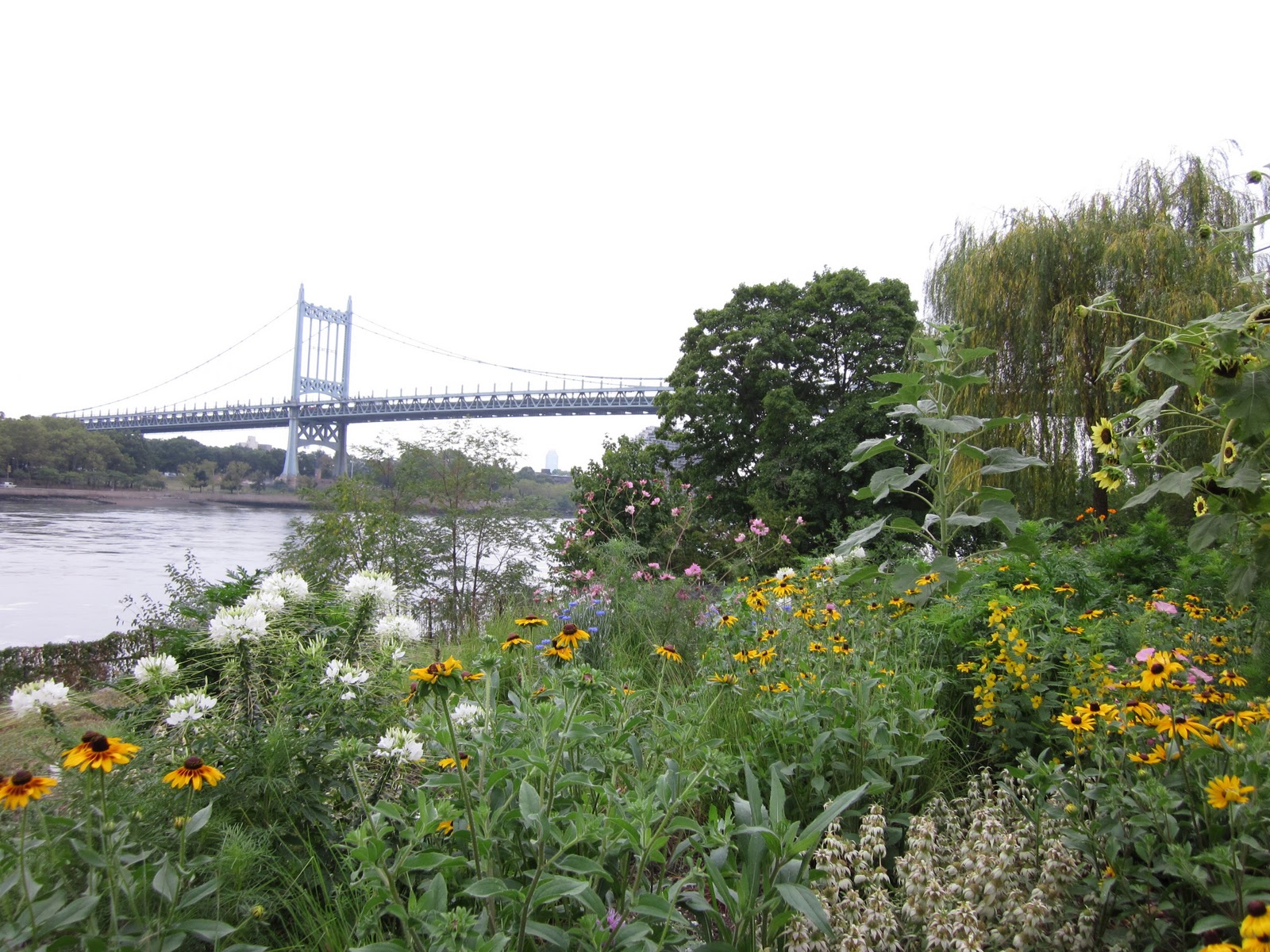
The native wildflower meadow at Randall's Island facing the Harlem River

Burrell traced the evolution of native plant movement/revival.
The call to arms:  think globally, act locally. 
The bumper sticker on his car:  DARWIN LOVES YOU.
Without recounting the entire lecture, as they say you can buy the book or books, Burrell ended the lecture by going locally...talking about his own garden.  A combination of garden and woodland. 
"I am a lazy gardener.   Native plants are a great way to sit outside, watch the butterflies, dragon flies, hummingbirds and have a glass of wine."  Burrell has a deer fence, which made him extremely happy, until the voles, moles, rabbits, skunks, and woodchucks invaded.  "Now, I 'm happy if it just lives, self-sows and makes a colony."

So am I.


C.Colston Burrell is a garden designer, award-winning author, photographer, naturalist, and teacher.  He is a lecturer in the College of Architecture and Landscape Architecture at the University of Virginia and principal of Native Landscape Design and Restoration.  He is the author of many gardening books adn has twice won the American Horticulture Society book award (in 2007 for Hellebores: A Comprehensive Guide and in 1998 for A Gardener's Encyclopedia of Wildflowers).  He is contributing editor for Horticulture and frequently write for Landscape Architecture and American Gardener.

Jan 21, 2010

A Series of Meringues - A Lecture by Dan Pearson

Speaking for 2 hours, hardly taking a breath, rattling off the names of  plants in every other sentence, Dan Pearson's lecture at The New York Botanical Garden on January 21 concentrated on BIG themes:  reading the landscape, sculpting the land and connecting to the environment.


Looking into Dan Pearson's garden in London from inside his house 
I characterize Pearson sensibility as typically English, but not his point of view.  He has a deep knowledge of plants, reverence for sense of place (see his new book featured on the right hand side of this page) and most importantly designs "gardens" so they appear to be non-designed.  He is part of the new wave garden mafia: Piet Oudolf and Ulf Nordfjel.  But his work is distinctly different.

THE GARDEN AS PORTRAIT
Every designer composes space and uses the interplay between hardscape and garden to their advantage.  For Pearson, the hardscape is recessive and uncomplicated, forming the bone structure for the garden, and the garden overlays this simple structure.  A garden in England where the old garden walls were covered with lichen, was one of the most interesting projects Dan choose to talk about.  For this designer, the old garden walls, became a road map for an evolving series of two garden rooms.  One of these rooms was sensual, dynamic and ephemeral.  The other was devoid of a perceived order.  It was "empty."  It was a series of landforms (convex & concave), created by Dan, with mowed paths.  It was a place to connect with the sky and the air.  The clients had requested a place to lie down and watch the stars and they got it.

THE GARDEN AS FOREST FLOOR
Acres of trees, a forest overgrown with bamboo from prior cutting, open areas with no plants, a restaurant:  all set against a background of mountains: this is the setting for a large project, Pearson is continuously working on.   It is not a garden, but a sustainable "park"  in Northern Japan, where the climate is rough:  Winters snow covered and cold:  Spring and Summer short and rainy. Studying the forest floor, how plants volunteer, self-seed, grow next to each other and into each other, crowd each other out, succession, regeneraton, and survival became the basis of the "created garden space" Dan designed near the restaurant.

THE GARDEN AS A DNA SEQUENCE
The plant palette Pearson used is extremely interesting, but that is the topic for another blog. I want to touch briefly on Pearson's idea for the planting scheme.  Dan developed 19 different planting combinations, with 5 or 6 plants in each combination, which began to look like a complicated sequence of DNA. The drawing reminded me of a chart from one of my chemistry classes. Visually the space seems "uncontrolled," more meadow-like then planned garden. This is the genius of the design, you feel overwhelmed by nature, but nature thoughtfully planted.

THE GARDEN AS SCULPTED FORM
In the flat baren area, Dan sculpted the land, bringing an 18th century British tradition to this rural Japanese landscape.  These landforms imitate to a certain degree the mountains that surround this landscape.  At the site, Dan built a small model using sand, of the landforms that would be created; this enabled him to play with the relationship between the forms and the mountains.  And interestingly, the landforms magnified the acoustics of the place. Making sound an important element in the space.

THE LECTURE AS DESSERT
In one of the final slides, Dan showed the landforms covered with snow, and he elegantly called it "a series of meringues." For me, this lecture was a meringue: light, delicate, magical and  rich.