
Two artists,
two great shows,
in one gray day,
at the end of March.
The experience of viewing a Bonnard painting is related to way I view a garden.
On the first walk around the current show at the Metropolitan Museum, I identify the “objects” in the paintings – a vase, a bowl of fruit, a chair. On the second walk around, the objects disappear and all I see are colors and textures. Wallpaper is pattern, flowers are colors, and figures are shapes. On the last walk around, my brain goes back to the narrative and the structure.
In a garden, I immediately identify the plants. On the second pass, I am consumed by texture and color and light. The garden is like a Bonnard interior. The structure fades away and sensual pleasure takes over.
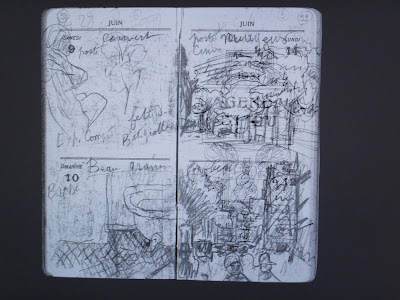
Perhaps, the most interesting part of the Met exhibition is a little room off the main gallery, filled with small calendars (3x6) Bonnard kept. These datebooks are covered with scribbles…ideas for paintings or just ideas.
Another artist, far from Southern France and the art world, also drew only the everyday objects and scenes in his native Idaho. James Castle, an artist born (1899-1977) deaf, who didn’t read or write, currently has two shows in New York. Without a big review in
The New York Times, I would never have paid attention to his work. He used found paper, soot from a wood burning stove and spit to make small drawings of his everyday surroundings that are sublime.
Bonnard never painted directly from “life,” he used the drawings he made as reference points to create his paintings. Castles’ work
is his drawings, watercolors and constructions.
With everything I love about the Blackberry, Iphone, and Ipod, these scribbles and drawings remind me how much is conveyed by the hand of an artist.
Can anything digital replace it?
Pierre Bonnard
The Late Interiors
January 27, 2009–April 19, 2009
Metropolitan Museum of Art
James Castle Drawings: Vision and Touch
Knoedler & Company
19 East 70 Street
Until April 25
James Castle
Ameringer Yohe Fine Art
20 West 57 Street

 Daffs are one of those ubiquitous flowers that I used to detest. They are everywhere at this time of year. Poems about them haven't moved me. Sunday walking through Central Park, I discovered something about a daffodil I do like: their back side. Suddenly a flower I've known all my life, looked different, interesting...the connection of stem to petal turned this very ordinary bulb into a mysterious funnel.
 email a friend |


 snap du jour (photo blog)