Nov 30, 2010

Making A List,
Checking It Twice...

i've checked out whose "naughty and nice". 
and...here's my must-have plant list for 2011.
1. Clematis x jouiniana 'Praecox'
BECAUSE as the BBC Plant Finder says
" it will happily scramble through borders...
and I need a ground cover that is unexpected and underused.
clematis x jouiniana 'Praecox'

2. Crocus sativus
BECAUSE saffron is the world's most expensive spice (by weight); you can grow it in the Northeast and its an autumn bloomer.  In the Spring, the plant sends up five to eleven narrow vertical green leaves; in autumn purple buds appear; in October its purple flowers develop.  A three-pronged style emerges from each flower, each prong terminates with a vivid crimson stigma = saffron.
crocus sativus
The saffron gatherer, reproduction of an ancient Theran wall painting (approx. 3600 years old) by Thomas Baker

BECAUSE the history of saffron reaches back more than 3,000 years.  C.sativus emerged late in Bronze Age Crete and you can still plant it in 2011.
geranium pretense 'Midnight Reiter'
3. Geranium maculatum 'Espresso'
Geranium pretense 'Midnight Reiter' 
BECAUSE I love dark purple foliage.  Fagus sylvatica 'Black Swan' does the trick when it comes to a tree, Physocarpus opulifolius 'Diablo' is a great shrub, and there are always the many heucheras from plum to dark burgundy that are workhorses in the garden.  But what if you want dark foliage in the sun, what then?  My answer:  Geranium maculatum 'Espresso' or Geranium pretense 'Midnight Reiter'.
4. Hakonechloa macra Nicolas
 Hakonechloa macra Nicolas
BECAUSE sometimes you want a waterfall and can't have one.  Hakonechloa is the plant that can cascade like nothing else and Nicolas can grow in the sun or so they say.  We shall see. 
 5. Scuttellaria incana
BECAUSE you don't see it very often; it blooms late in the season; the leaves turn purple in the fall; and nothing is more beautiful than its seed heads. 
 Scuttelaria incana

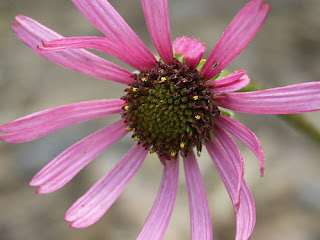
6. Echinacea tennesseensis 'Rocky Top'
 Echinacea tennesseensis 'Rocky Top'
BECAUSE even though there are many Echinaceas on the market and everyone is kind of sick of them, Echinacea tenesseenis is on the endangered species list.  The flowers always face EAST, not traveling with the sun like most Echinaceas.  In researching this little tidbit, I found out that this Echinacea can be traced back to the last Ice Age.
7. Phlomis tuberosa 'Amazone'
BECAUSE its easy to grow, has a beautiful structure, magnificent seed heads and it's a favorite of Beth Chatto.

  8. Amsonia hubrichtii 
BECAUSE although the willow-like foliage is great when contrasted with a heavier leaf, the real story is the golden bronze color Amsonia hubrichtii turns in the fall and I appreciate the fact that it is one of our native American plants.
My resolution for 2011:
I won't be crying or pouting, just digging in the soil.

Nov 23, 2010

The Tables Have Turned

Arbores Laetae (Joyful Trees) 2008
Diller, Scofiodio +Renfro
Installation:  Liverpool Biennial

I am always a little behind the times, but this time, it seems I missed Arbores Laetae, an installation piece by the Highline architects from 2008.  I thought it was interesting enough to draw attention to it.
"Dismissing the conventional distinctions between "nature" and "artifice" a brownfield site along a key route in the city center is the host of a new pubic park.  A small grove of hornbeam trees, some electrically-assisted, upsets the perception of a stable ground.  Three central trees are planted eccentrically and at a 10-degree bias in deep planter box turntables.  The three turntables are synchinorized to rotate slowly at slightly different speeds.  Changing orbits cause the trees to occasionally brush against one another or open up a wide void in the grove while the texture of dappled light and shade is in constant play.  The experience is disorienting.  From a vantage point on a spinning platform, the context appears to shift.  From terra firma, the trees uncannily animate around and past you. "
- Diller Scofiodio + Renfro
And don't forget to watch the video.  It gives some idea of what it was like to be there.


Also in a strange way, a related blog written by Paula Panich on November 22, 2010, entitled, Every Tree Tells a Story...If We're Listening,  is an interesting to compliment to the Diller Scofiodio piece.


Nov 17, 2010

A Walk On The Wild Side: Hidcote


"What he did was to sum up the English dream of the Italian garden." 
Ethne Clark

"...But perhaps our collective memory of this most beguiling and influential garden
has been playing tricks on us."
Noel Kingsbury
I am not a landscape historian.  You won't find me crawling around archival material, looking through old letters or diaries.  I prefer the art of projection and conjecture.
 My Window at Hidcote

In July 2010, I lived in the Manor House at Hidcote.  During the early morning hours, before work, I prowled around the garden.  Walking through enclosed rooms, wondering what was really going on in Lawrence Johnston's head.
 Walking through one of the garden rooms at Hidcote

The short and long of it is that Lawrence Johnston was a American expat, who created the quintessential English arts and crafts garden.  The idea that there is anything "American" about the garden, especially any Yankee influence would be pure heresy.  

Lawrence Johnston, plant hunter, plant explorer, garden designer, Anglophile, couldn't escape a childhood memory of something much more unfettered, less controlled, more "American".  Hidcote, may be an iconic English garden, but does it have its origins in its creators wide open country?

That is my theory.  But I needed some back-up.

I consulted a psychoanalyst, not a therapist, to find out if the basis for believing our earliest memories of landscape consciously or unconsciously, influence the gardens we create.

I took myself as a case in point.  I grew up in a middle class neighborhood, where every lawn and backyard looked like hairspray had been applied to all things green.  My father, had an affinity for open spaces, particularly the White Mountains of New England, the Grand Tetons of Wyoming and the Alps of Switzerland.  He threw a monkey wrench into our subdued, acceptable garden by planting dahlias in outrageous colors, tulips in the wrong places and tomatoes next yews.  He erred on the wild side.

Thinking about my own garden predilections, I have been reflecting on their origins.  It would be comforting to think that the gardens, I have created, are the result of schooling, reading, traveling and conversations, but I have a feeling that something more elemental is at work.

It's not the place, the size, the flowers or shrubs.  It's something metaphorical.  It's practically indefinable.  What has formed a good part of what I "like" in a garden - or what I respond to or what I want to make is a walk on the wild side.
 

11/17/2010
for roz & paul


Nov 12, 2010

Space Unfolding:
Paula Deitz


and that is the title of her new book.  A well-known fixture in the garden writing world, Ms. Deitz's academic background distinguishes her from others in the field.  Where she sees an open vista and is reminded of a Frederick Church painting, another might see a meadow filled with drifts of echinacea and monarda.

"The moment has to be right, a little after eight o'clock.  Suddenly moving slowly up and down both sides of the center islands, school buses and taxis fill the slick dark avenue with chrome-yellow shapes that gleam in the rain.  I move away for an instant, then, when I look again, this world in a mist seems transformed into a stream in an old Kyoto garden where golden carp weave in and out of dark waters, their backs glistening as they turn." excerpt from A Winter Garden of Yellow, New York Times, February 27, 1995 collected in Of Gardens.

Ms. Deitz spoke to a packed house at the Annual Meeting of The Horticultural Society of New York on Thursday night.  Her topic The Abby Aldrich Rockefeller Garden on Mt. Desert Island.  As one expects from a landscape historian, Ms. Deitz began with a 19th century map of the island and the origin of the name.

"Some natives stress the second syllable (de-ZERT), in the French fashion, although many others pronounce it in a fashion similiar to the English name of a landscape devoid of vegetation (DEH-zert). French explorer Samuel de Champlain's observation that the summits of the island's mountains were free of vegetation as seen from the sea led him to call the island "Ile des Monts Deserts", or island of the bare mountains."
Wikipedia

Ms. Deitz spends her summers in Maine.  Her relationship to the Rockefeller Garden at Seal Harbor is part neighbor and part historian.  This personal relationship to the past and present owners give her unique access and perspective.


The Rockfellers were inspired to create the garden at Seal Habor after a trip to Peking for the opening of the Peking Union Medical College.  What was it that inspired them to take a rugged part of the Maine coast and turn it into an Asian garden?

Ms. Deitz alluded to the answer.  Mrs. Abbey Aldrich Rockerfeller had a predilection for quiet spaces and saw the opportunity to turn her Maine property into a refuge.  Mrs. Rockefeller is quoted as saying
"only gardens know how to yield such happiness."

After working at Hidcote this summer,  I wondered if Lawrence Johnson, the creator of Hidcote, was influenced by his passion for all things English or if there was any remnant of his American childhood that influenced his building of the gardens at Hidcote. 
For me, gardens can yield happiness, but also sleepless nights.  In the case of the origins of the  garden at Seal Harbor, Deitz provided me with a good night's sleep.


Track Your Happiness


 How simple and frugal a thing is happiness:
a glass of wine, a roasted chestnut, a wretched little brazier, the sound of the sea...
All that is required to feel that here and now is happiness is a simple frugal heart.
Nikos Kazantzakis

In a follow up to the blog I wrote two days ago about Nordic Designers, especially Nille Juul-Sorenson and his remarks on the iphone's ability to become individualized. 

Others have found an additional use for the iphone in the world of scientific research. It seems psychologists at Harvard have figured out how to do a scientific study by developing an iphone app.  No need to enlist people to become part of a study.  This study simply asks people all over the world to upload the app:  Track Your Happiness.

It seems we are happiest when we are in the moment, when we focus.